- Swarmfarm Robotics — His previous weed sprayer weighed 21 tonnes, measured 36 metres across its spray unit, guzzled diesel by the bucketload and needed a paid driver who would only work limited hours. Two robots working together on Bendee effortlessly sprayed weeds in a 70ha mung-bean crop last month. Their infra-red beams picked up any small weeds among the crop rows and sent a message to the nozzle to eject a small chemical spray. Bate hopes to soon use microwave or laser technology to kill the weeds. Best of all, the robots do the work without guidance. They work 24 hours a day. They have in-built navigation and obstacle detection, making them robust and able to decide if an area of a paddock should not be traversed. Special swarming technology means the robots can detect each other and know which part of the paddock has already been assessed and sprayed.
- Route to Market (Matt Webb) — The route to market is not what makes the product good. […] So the way you design the product to best take it to market is not the same process to make it great for its users.
- Explorable Explanations — points to many sweet examples of interactive explorable simulations/explanations.
- I-JSON (Tim Bray) — I-JSON is just a note saying that if you construct a chunk of JSON and avoid the interop failures described in RFC 7159, you can call it an “I-JSON Message.” If any known JSON implementation creates an I-JSON message and sends it to any other known JSON implementation, the chance of software surprises is vanishingly small.
"business models" entries


Four short links: 23 March 2015
Agricultural Robots, Business Model Design, Simulations, and Interoperable JSON

From factory to data center: The O’Reilly Radar Podcast
Nate Oostendorp on manufacturing and the industrial Internet, and Tim O'Reilly and Rod Smith discuss emerging tech.
Editor’s note: you can subscribe to the O’Reilly Radar Podcast through iTunes,SoundCloud, or directly through our podcast’s RSS feed.
The Industrial Revolution had a profound effect on manufacturing — will the industrial Internet’s effect be as significant? In this podcast episode, Nate Oostendorp, co-founder and CTO of Sight Machine, says yes — where mechanization ruled the Industrial Revolution, data-driven automation will rule this next revolution:
“I think that when you think about manufacturing 20 years from now, the computer and the network is going to be much more fundamental. Your factories are going to look a lot more like data centers do, where there’s a much greater degree of automation that’s driven by the fact that you have good data feeds off of it. You have a lot of your administration of the factory that will be done remotely or in a back office. You don’t necessarily need to have engineers on a floor watching a machine in order to know what’s going on. I think fundamentally, the number of players in a factory will be much smaller. You’ll have much more technical expertise but a fewer number of people overall in a factory setting.”
According to Oostendorp, we’re already seeing the early effects today in an increased focus on quality and efficiency. Read more…

The return of local retail?
Local retail revival won't hinge on online-style consumer data intrusion; it will require getting back to basics.
About a month ago, IBM published its five tech predictions for the next few years. They’re mostly the sort of unexceptional things one predicts in this sort of article — except for one: the return of local retail.
This is a fascinating idea, both in the ways I agree and the ways I disagree. First, I don’t think local retail is quite as dead as many people thought. Now that Borders is no longer with us and Barnes and Noble is on the ropes, I see more activity in local bookstores. And the shopping district in the center of my town is full; granted, we’re talking reasonably prosperous suburbia, not Detroit, but not too many years ago there was no shortage of empty storefronts.
What surprised me was the reason IBM thought local retail would return. They observed that many of the same techniques that Amazon and other online retailers use can be applied locally. You walk into a store; you’re identified by your cell phone (or some other device); the store can look up your purchase history, online history, etc.; it can then generate purchase recommendations based on inventory; and send over a salesperson — with an informed view of who you are, what you’re likely to buy, and so on — to “help” you. Read more…

If followers can sponsor updates on Facebook, social advertising has a new horizon
The frequency of sponsored posts looks set to grow.
This week, I found that one of my Facebook updates received significantly more attention that others I’ve posted. On the one hand, it was a share of an important New York Times story focusing on the first time a baby was cured of HIV. But I discovered something that went beyond the story itself: someone who was not my friend had paid to sponsor one of my posts.
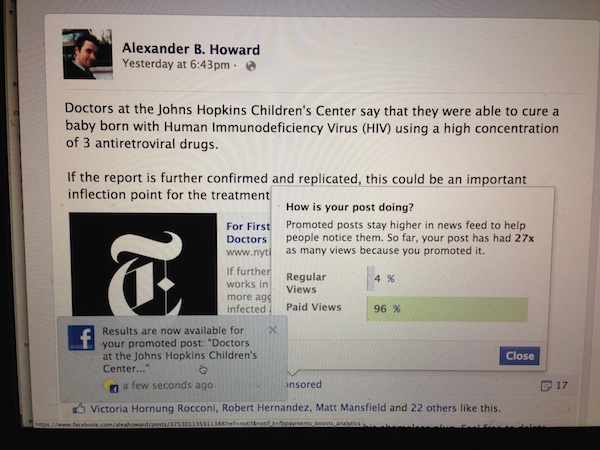
According to Facebook, the promoted post had 27 times as many views because it was sponsored this way, with 96% of the views coming through the sponsored version.
When I started to investigate what had happened, I learned that I’d missed some relevant news last month. Facebook had announced that users would be able to promote the posts of friends. My situation, however, was clearly different: Christine Harris, the sponsor of my post, is not my friend.
When I followed up with Elisabeth Diana, Facebook’s advertising communications manager, she said this was part of the cross-promote feature that Facebook rolled out. If a reporter posts a public update to his followers on Facebook, Diana explained to me in an email, that update can be promoted and “boosted” to the reporter’s friends.
While I couldn’t find Harris on Facebook, Diana said with “some certainty” that she was my follower, “in order to have seen your content.” Harris definitely isn’t my friend, and while she may well be one of my followers, I have no way to search them to determine whether that’s so. Read more…

Tip for B&N: Don't just follow Amazon
Joseph Esposito on Amazon's dominant position and what B&N can do about it.
Amazon is the clear market leader, but that doesn’t mean everyone else should throw in the towel. In this podcast, Joseph Esposito, president of Portable CEO consulting, discusses the current publishing market and how B&N can best compete.
Four short links: 12 September 2011
History Repeats, Fuller Feeds, Open Source Dev, and The Long Sunset of Business Models
- HP Emulates Next (BoingBoing) — In mid-1993, a few months after CEO Steve Jobs had shuttered the NeXT factory, and was in the process of switching to an all-software company—a path that led to its later acquisition by Apple—the lights were turned back on in its Fremont, Calif., factory. NeXTWorld’s rumor columnist, Lt. Sullivan, reported that the U.S. military and another undisclosed customer wanted more machines, and so NeXT was to fire up and spit 1,200 more devices out.
- FeedsAPI — service that turns a feed of partial posts into a full feed.
- Cinderella — a fully managed development environment for open source hacking on Mac OSX. It’s powered by homebrew and chef. You only need Xcode to get started. (via One Thing Well)
- The Greenwich Time Lady (Futility Closet) — the old and the new coexist. From 1836 to 1940, this one company sold the time to people; their pocketwatch was certified by Greenwich Observatory in the morning and for the rest of the day they charged to look at it. New technology, government standards, and plenty of competition didn’t end the business instantly. Compare to Clay Shirky’s That is what real revolutions are like. The old stuff gets broken faster than the new stuff is put in its place.

Ebooks and the threat from "internal constituencies"
Lessons from adjacent media companies can inform publishers' ebook strategies.
Will internal constituencies bias how publishers value print book and ebook business models? Roger Magoulas examines that question and looks at the complementary relationship between print and electronic forms.

Publishing Models for Internet Commerce
Last week I pointed to a 1994 interview Tim O'Reilly did that touched on the impact the Web would have on publishing. A nice contemporary companion is this 1995 paper titled "Publishing Models for Internet Commerce" that remains relevant (perhaps more so) today: In an information glut, it is not content but context that is king. Someone chooses the…
Anderson: "It's All About Attention"
Over on Spiegel Online, Chris Anderson does a great job responding to nearly all of the standard old-media responses to new media. Unsurprisingly (I’m sure Wired would have done the same) they pulled one line from a lengthy response to create the provocative title “Maybe Media Will Be a Hobby Rather than a Job.” The full passage is much more useful and nuanced:
Extraordinary Piece on the Future (and Past) of Digital Books
Over on Ars Technica, John Siracusa revisits the history of the ebook, and explains why he thinks there's very much a future in digital reading