- Android Malware Numbers — (Quartz) less than an estimated 0.001% of app installations on Android are able to evade the system’s multi-layered defenses and cause harm to users, based on Google’s analysis of 1.5B downloads and installs.
- Facebook Operations Chief Reveals Open Networking Plan — long interview about OCP’s network project. The specification that we are working on is essentially a switch that behaves like compute. It starts up, it has a BIOS environment to do its diagnostics and testing, and then it will look for an executable and go find an operating system. You point it to an operating system and that tells it how it will behave and what it is going to run. In that model, you can run traditional network operating systems, or you can run Linux-style implementations, you can run OpenFlow if you want. And on top of that, you can build your protocol sets and applications.
- How Red Bull Dominates F1 (Quartz) — answer: data, and lots of it.
- Ground-Level Air Pollution Sensor (Make) — neat sensor project from Make.
"environment" entries

Sustainability
What will stop the march of technological progress?
 Tim O’Reilly gave some sobering remarks last week at Techonomy about the things that might halt the sort of technological progress that has come to feel inexorable: war, fundamentalism, anti-science sentiment, etc. Human progress has practically stopped over many long periods in recorded history, he pointed out, and we won’t necessarily be able to predict the next dark age by reading out from the patterns of history.
After the conference ended, I spent the afternoon driving to San Diego across some really spectacular Sonoran terrain that’s been repeatedly reshaped by cataclysmic floods and dried out by thousand-year droughts in a flourish/perish cycle that’s much longer than any in human history. I took a long side-trip to see the Salton Sea, which is an accidental re-creation of an ancient lake, formed in 1905 when a canal levy that was built during a period of land speculation broke and diverted the entire flow of the Colorado River into a below-sea-level basin for two years. The highly-saline ecological disaster that resulted, and the horizon-to-horizon industrial farming that surrounds it, is really striking for the relentless speed at which that environment was created on human terms and in cycles that are totally uncoupled from nature’s.
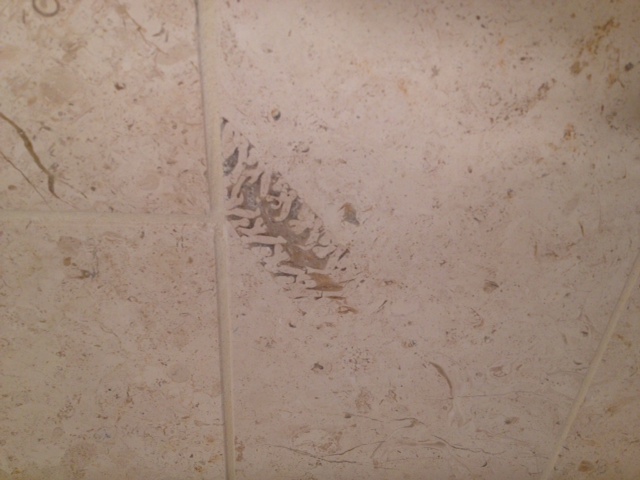
The punch line to a day of thinking about sustainability came on checking into a pretty ordinary hotel in San Diego and finding the scene in the above photo: bathroom tiles full of ancient fossils that were preserved and stored on a timeline of millions of years and rendered into building materials on a timeline that’s probably six orders of magnitude shorter.


Four short links: 9 October 2013
Android Malware Numbers, Open Networking Hardware, Winning with Data, and DIY Pollution Sensor
Four short links: 22 July 2013
Antivirus Numbers, 3D Printer Explosion, 3D Printing's Particulate Problem, and Simulating Touch
- The Anti-Virus Age is Over — for every analyst that an AV company hires, the bad guys can hire 10 developers.
- 3D Printing’s 2014 Renaissance (Quartz) — patents on sintering about to expire which will open up hi-res production. Happened in the past when patents on fixed deposition modelling expired: Within just a few years of the patents on FDM expiring, the price of the cheapest FDM printers fell from many thousands of dollars to as little as $300.
- Ultrafine Particle Emissions from Desktop 3D Printers (Science Direct) — Because most of these devices are currently sold as standalone devices without any exhaust ventilation or filtration accessories, results herein suggest caution should be used when operating in inadequately ventilated or unfiltered indoor environments. (via Slashdot)
- Aireal — focussed changes in air pressure simulate sensations of touch. The machine itself is essentially a set of five speakers in a box–subwoofers that track your body through IR, then fire low frequencies through a nozzle to form donut-like vortices (I imagine the system as a cigar-smoking Microsoft Kinect). […] In practice, Aireal can do anything from creating a button for you to touch in midair to crafting whole textures by pulsing its bubbles to mimic water, stone, and sand. (via BoingBoing)
Four short links: 28 February 2013
Equity of Access, Smartphone Rare Earths, Nanoquadrocopter, and Macmillan Expands in Open Science
- Myth of the Free Internet (The Atlantic) — equity of access is an important issue, but this good point is marred by hanging it off the problematic (beer? speech? downloads?) “free”. I’m on the council of InternetNZ whose mission is to protect and promote the open and uncaptureable Internet. (A concept so good we had to make up a word for it)
- Periodic Table of the SmartPhone (PDF, big) — from Scientific American article on Rare Earth Minerals in the Smartphone comes a link to this neat infographic showing where rare earth elements are used in the iPhone. (via Om Malik)
- CrazyFlie Nano Preorders — 19g, 9cm x 9cm, 20min charge time for 7m flight time on this nano-quadrocopter. (via Wired)
- Changing Scientific Publishing (The Economist) — Nature buys an alternative journal publisher (30 titles in 14 scientific fields), which comes with an 80k-member social network for scientists. Macmillan are a clever bunch. (O’Reilly runs Science Foo Camp with Macmillan’s Digital Sciences and Google)
Four short links: 22 August 2012
Minecraft Devastation, Constructive Dialog, Oatmeal Rocks, and Pwning Printers
- Minecraft Experiment Devolves into Devastating Resource War — life imitates art, but artificial life imitates, well, Haiti.
- Finding Unity in the Math Wars — I recently heard a quote about constructive dialog: “Don’t argue the exact point a person made. Consider their position and respond to the best point they could have made.” I like this! (and the point that math teachers fighting with each other is missing an opportunity to fight for the existence of math education) (ps, “unity … math”, I see what you did there)
- Tesla Museum Funded — Matthew Inman, cartoonist behind The Oatmeal, used IndieGogo to raise over $850k to buy Tesla’s old building in New York and turn it into a museum. In five days. There are still 39 days to run. Impressive channeling of his audience for good.
- Printers Spontaneously Printing “SQL” Strings (Hacker News) — it’s a sign that someone’s scanning your network for vulnerable web apps, found the exposed printer port, and sent an malignant HTTP request to it.
Four short links: 17 April 2012
Animal Imagery, Infectious Ideas, Internet v Books, and Transparency Projects
- Penguins Counted From Space (Reuters) — I love the unintended flow-on effects of technological progress. Nobody funded satellites because they’d help us get an accurate picture of wildlife in the Antarctic, but yet here we are. The street finds a use …
- What Makes a Super-Spreader? — A super-spreader is a person who transmits an infection to a significantly greater number of other people than the average infected person. The occurrence of a super spreader early in an outbreak can be the difference between a local outbreak that fizzles out and a regional epidemic. Cory, Waxy, Gruber, Ms BrainPickings Popova: I’m looking at you. (via BoingBoing)
- The Internet Did Not Kill Reading Books (The Atlantic) — reading probably hasn’t declined to the horrific levels of the 1950s.
- Data Transparency Hacks — projects that came from the WSJ Data Transparency Codeathon.
Four short links: 3 August 2011
Library Licensing, Mac Graphics, Coal Computing, and Human Augmentation
- Just Say No To Freegal — an interesting view from the inside, speaking out against a music licensing system called Freegal which is selling to libraries. Libraries typically buy one copy of something, and then lend it out to multiple users sequentially, in order to get a good return on investment. Participating in a product like Freegal means that we’re not lending anymore, we’re buying content for users to own permanently so they don’t have to pay the vendor directly themselves. This puts us in direct competition with the vendor’s sales directly to consumers, and the vendors will never make more money off of libraries than they will off of direct consumer sales. What that does is put libraries in a position of being economic victims of our own success. I would think that libraries would remember this lesson from our difficulties with the FirstSearch pay-per-use model that most of us found to be unsustainable.
- Radi — a Mac app that can produce pretty much any kind of visual content for the web. Images, animations, vector graphics, video clips, realtime visual effects, JavaScript programming…. (via Hacker News)
- Cost of Computing in Coal (Benjamin Mako Hill) — back-of-the-envelope estimation of the carbon costs of running an overnight multicore Amazon number-crunching job. Thinking about the environmental costs of your crappy coding might change the way you code, much as punched cards encouraged you to model and test the program by hand before you ran it. How many tons of coal are burnt to support laziness or a lack of optimization in my software?
- Friction in Computer Human Symbiosis (Palantir blog) — Weak human + machine + better process was superior to a strong computer alone and, more remarkably, superior to a strong human + machine + inferior process. (via Tim O’Reilly)

Sustainable publishing is a mindset, not a format
Dennis Stovall on the intricacies of sustainable publishing.
Dennis Stovall, director of the Publishing Program at Portland State University, discusses the state of sustainable publishing and who's doing it right.

Can we capture all the world's carbon emissions?
Carbon capture tech would require huge scale, but could give the world needed time.
Capturing carbon dioxide from the atmosphere has major challenges, but it can be done at a price that would not destroy our economy. Doing so would give us more time to find ways to switch to inherently zero-carbon methods of powering our civilization.
The Moore's Law of solar energy
Solar cost per watt is dropping on an exponential curve, and will drop below coal by 2020.
If humanity could capture one tenth of one percent of the solar energy striking the Earth, we would have access to 6X as much energy as we consume in all forms today, with almost no greenhouse gas emissions.