- More Git and GitHub Secrets (Zach Holman) — wizards tricks. (via Rowan Crawford)
- Building a Keyboard from Scratch (Jesse Vincent) — for the connoisseur.
- Practicing Deployment (Laura Thomson) — you should build the capability for continuous deployment, even if you never intend to continuously deploy.
- 3D Printed Atoms (Thingiverse) — customize and 3d-print a Bohr model of any atom.
"github" entries


Four short links: 25 July 2013
Git Secrets, Ab Initio Keyboard, Continuous Deployment, and 3D Atomic Models
Four short links: 19 June 2013
Thread Problems, Better Image Search, Open Standards, and GitHub Maps
- Multithreading is Hard — The compiler and the processor both conspire to defeat your threads by moving your code around! Be warned and wary! You will have to do battle with both. Sample code and explanation of WTF the eieio barrier is (hint: nothing to do with Old McDonald’s server farm). (via Erik Michaels-Ober)
- Improving Photo Search (Google Research) — volume of training images, number of CPU cores, and Freebase entities. (via Alex Dong)
- Is Google Dumping Open Standards for Open Wallets? (Matt Asay) — it’s easier to ship than standardise, to innovate than integrate, but the ux of a citizen in the real world is pants. Like blog posts? Log into Facebook to read your friends! (or Google+) Chat is great, but you’d better have one client per corporation your friends hang out on. Nobody woke up this morning asking for features to make web pages only work on one browser. The user experience of isolationism is ugly.
- GitHub Renders GeoJSON — Under the hood we use Leaflet.js to render the geoJSON data, and overlay it on a custom version of MapBox’s street view baselayer — simplified so that your data can really shine. Best of all, the base map uses OpenStreetMap data, so if you find an area to improve, edit away.

Strata Week: Intel wants you to reap the benefits from your personal data
Intel's Data Economy Initiative, your personal records are exposed, Sears gets into the data center business, and ODI wants Git for data publishing.
Intel’s taking the lead in the new “data economy”
Intel is looking to take the lead in what it has dubbed the “data economy,” helping consumers and individuals realize and retain more value from their personal data. Antonio Regalado and Jessica Leber report at MIT Technology Review that the the world’s largest computer chip maker has launched a “Data Economy Initiative.” Ken Anderson, a cultural anthropologist who is in charge of the project, described the initiative to them as “a multiyear study whose goal is to explore new uses of technology that might let people benefit more directly, and in new ways, from their own data.”
As part of the initiative, Intel is funding hackathons to encourage developers to experiment with personal data in new ways, Regalado and Leber note. “[Intel] has also paid for a rebellious-sounding website called We the Data,” they report, “featuring raised fists and stories comparing Facebook to Exxon Mobil.” Read more…

The City of Chicago wants you to fork its data on GitHub
Chicago CIO Brett Goldstein is experimenting with social coding for a different kind of civic engagement.
GitHub has been gaining new prominence as the use of open source software in government grows.
Earlier this month, I included a few thoughts from Chicago’s chief information officer, Brett Goldstein, about the city’s use of GitHub, in a piece exploring GitHub’s role in government.
While Goldstein says that Chicago’s open data portal will remain the primary means through which Chicago releases public sector data, publishing open data on GitHub is an experiment that will be interesting to watch, in terms of whether it affects reuse or collaboration around it.
In a followup email, Goldstein, who also serves as Chicago’s chief data officer, shared more about why the city is on GitHub and what they’re learning. Our discussion follows.
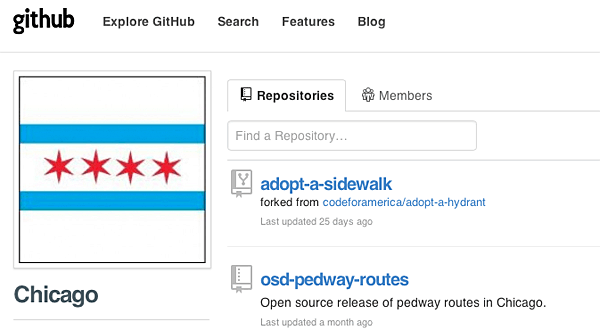
The City of Chicago is on GitHub.
GitHub gains new prominence as the use of open source within governments grows
The collaborative coding site hired a "government bureaucat."
 When it comes to government IT in 2013, GitHub may have surpassed Twitter and Facebook as the most interesting social network.
GitHub’s profile has been rising recently, from a Wired article about open source in government, to its high profile use by the White House and within the Consumer Financial Protection Bureau. This March, after the first White House hackathon in February, the administration’s digital team posted its new API standards on GitHub. In addition to the U.S., code from the United Kingdom, Canada, Argentina and Finland is also on the platform.
“We’re reaching a tipping point where we’re seeing more collaboration not only within government agencies, but also between different agencies, and between the government and the public,” said GitHub head of communications Liz Clinkenbeard, when I asked her for comment. Read more…
Four short links: 1 February 2013
Icon Font Fun, Rails Security, Indie Economics, and GitHub MITMed in China
- Icon Fonts are Awesome — yes, yes they are. (via Fog Creek)
- What the Rails Security Issue Means for Your Startup — excellent, clear, emphatic advice on how and why security matters and what it looks like when you take it seriously.
- The Indiepocalypse (Andy Baio) — We’re at the beginning of an indiepocalypse — a global shift in how culture is made, from a traditional publisher model to independently produced and distributed works.
- China, GitHub, and MITM — No browser would prevent the authorities from using their ultimate tool though: certificates signed by the China Internet Network Information Center. CNNIC is controlled by the government through the Ministry of Industry and Information Technology. They are recognized by all major browsers as a trusted Certificate Authority. If they sign a fake certificate used in a man-in-the-middle attack, no browser will warn of any usual activity. The discussion of how GitHub (or any site) could be MITM’d is fascinating, as is the pros and cons for a national security agency to coopt the certificate-signing NIC.
Four short links: 4 January 2013
SSH/L Multiplexer, GitHub Bots, Test Your Assumptions, and Tech Trends
- sslh — ssh/ssl multiplexer.
- Github Says No to Bots (Wired) — what’s interesting is that bots augmenting photos is awesome in Flickr: take a photo of the sky and you’ll find your photo annotated with stars and whatnot. What can GitHub learn from Flickr?
- Four Assumptions of Multiple Regression That Researchers Should Always Test — “but I found the answer I wanted! What do you mean, it might be wrong?!”
- Tenth Grade Tech Trends (Medium) — if you want to know what will have mass success, talk to early adopters in the mass market. We alpha geeks aren’t that any more.
Four short links: 12 December 2012
Evidence-Based Movie Arguments, Open Source on Github, Reality Glitches, and Lens-Up Displays
- Kiwi Bond Films Are The Most Violent (Peter Griffin) — it wasn’t always furry-footed plucky adventurers in Middle Earth, my friends. Included to show that you can take an evidence-based approach to almost any argument.
- Are Githubbers Taking Open Source Seriously? — nearly 140 of the 175 projects analyzed contain such an easily findable license information, or more precisely 78%. Or, alternatively 22% of Github projects don’t have easily findable license information. zomg. (via Simon Phipps)
- The Oh Shit (Matt Jones) — the condition of best-laid plans meeting reality. When all the drawings, sections, detailed drawings and meticulous sourcing in the world clash with odd corners of the physical world, weather, materials and not least the vagaries of human labour. It’s what Bryan Boyer calls the “Matter Battle”. He puts it beautifully: “One enters a Matter Battle when there is an attempt to execute the desires of the mind in any medium of physical matter.”
- Text Messages Direct to your Contact Lens (The Telegraph) — I want this so bad. It’s a future I can believe in. Of course, the free ones will have spam.
Four short links: 21 November 2012
Commandline Gists, Pixel Tools, Indie Business Case Study, and Adobe Tablet Tool
- gboom — commandline tool for making gists.
- Pixel Based Websites — great collection of Javascript tools for working with sprites and backgrounds.
- Indie Game The Movie: Case Study — lessons learned, lots of detail, about the self-publishing crowdfunding success story of this documentary. Last piece in the series busts the myth that only big name people can make it work. (via Andy Baio)
- Adobe Proto — tablet app for making prototypes and wireframes. (via Josh Clark)

Curiosity turned loose on GitHub data
Ilya Grigorik's GitHub project shows what happens when questions, data, and tools converge.
 I’m fascinated by people who:
1. Ask the question, “I wonder what happens if I do this?” and then follow it all the way through.
2. Start a project on a whim and open it up so anyone can participate.
Ilya Grigorik (@igrigorik) did both of these things, which is why our recent conversation at Strata Conference + Hadoop World was one of my favorite parts of the event.
By day, Grigorik is a developer advocate on Google’s Make the Web Fast team (he’s a perfect candidate for a future Velocity interview). On the side, he likes to track open source projects on GitHub. As he explained during our chat, this can be a time-intensive hobby:
“I follow about 3,000 open source projects, and I try to keep up with what’s going on, what are people contributing to, what are the new interesting sub-branches of work being done … The problem I ran into about six months ago was that, frankly, it was just too much to keep up with. The GitHub timeline was actually overflowing. In order to keep up, I would have to go in every four hours and scan through everything, and then repeat it. That doesn’t give you much time for sleep.” [Discussed 15 seconds into the interview.]
Grigorik built a system — including a newsletter— that lets him stay in the loop efficiently. He worked with GitHub to archive public GitHub activity, and he then made that data available in raw form and through Google BigQuery (the data is updated hourly).
This is a fun project, no doubt, but it’s also a big deal. Here’s why: When you shorten the distance between questions and answers, you empower people to ask more questions. It’s the liberation of curiosity, and that’s exactly what happened here. Read more…