Menu
"law" entries


Twitter Emoji, Immersive Cinema, Bitcoin Regulation, and Internet Sovereignty
-
Twitter Open Sources Their Emoji Library — Emoji are the sparklines of sentiment.
-
Interactive 360-degree Films. From Google (Medium) — you move the camera through a movie shot in 360 degrees, and can choose what you’re looking at through the scene. I can’t wait to try this, it sounds brilliant.
-
Bitcoin Crackdown — everyone who started exchanges and mutual funds thinking Bitcoin wouldn’t be regulated like a currency is getting an SEC headache.
-
Connected Choices: How the Internet is Challenging Sovereign Decisions (PDF) — Ultimately, the Internet remains both a global commons and part of each nation’s sovereign infrastructure, and thus activities in cyberspace must continue to navigate two sets of demands: national interests and global interests. […] Political leaders are responsible for articulating a vision and establishing general principles and policies to achieve their goals and, accordingly, are constantly trying to advance their agendas using policy, law, market mechanisms, regulation, standards, and other initiatives. The evidence is clear; you just have to look for it.
Bubble Talk, Pants Build, HTML Processing, and Use Regulation
-
Bill Gurley on Startups and Risk (Business Insider) — No one’s fearful, everyone’s greedy, and it will eventually end.
-
Pants — a build system from Twitter and others.
-
pup — commandline tool for parsing and processing HTML.
-
Use Regulation (Slate) — the take on privacy that says that data collection isn’t inherently bad, it’s the (mis)use of the data that should be policed. The author of this piece is not a believer.
Visual Python, Scraping and Screenshotting, Un-free Speech, IP Law Textbook
-
PlotDevice — A Python-based graphics language for designers, developers, and tinkerers. More in the easy-to-get-started + visual realm, like Processing. (via Andy Baio)
-
Scumblr and Sketchy Search — Netflix open sourcing some scraping, screenshot, and workflow tools their security team uses to monitor discussion of themselves.
-
Should Twitter, Facebook and Google Executives be the Arbiters of What We See and Read? (Glenn Greenwald) — In the digital age, we are nearing the point where an idea banished by Twitter, Facebook and Google all but vanishes from public discourse entirely, and that is only going to become more true as those companies grow even further. Whatever else is true, the implications of having those companies make lists of permitted and prohibited ideas are far more significant than when ordinary private companies do the same thing.
-
Intellectual Property: Law and the Information Society; Cases and Materials (PDF) — James Boyle and Jennifer Jenkins’ open law textbook on IP (which even explores the question of whether that’s a valid and meaningful term). (via James Boyle)
Data Storytelling Tools, Massive Dataset Mining, Failed Crowdsourcing, and IoT Networking
-
Miso — Dataset, a JavaScript client-side data management and transformation library, Storyboard, a state and flow-control management library & d3.chart, a framework for creating reusable charts with d3.js. Open source designed to expedite the creation of high-quality interactive storytelling and data visualisation content.
-
Mining of Massive Datasets (PDF) — book by Stanford profs, focuses on data mining of very large amounts of data, that is, data so large it does not fit in main memory. Because of the emphasis on size, many of our examples are about the Web or data derived from the Web. Further, the book takes an algorithmic point of view: data mining is about applying algorithms to data, rather than using data to “train” a machine-learning engine of some sort.
-
Lessons from Iceland’s Failed Crowdsourced Constitution (Slate) — Though the crowdsourcing moment could have led to a virtuous deliberative feedback loop between the crowd and the Constitutional Council, the latter did not seem to have the time, tools, or training necessary to process carefully the crowd’s input, explain its use of it, let alone return consistent feedback on it to the public.
-
Thread a ZigBee Killer? — Thread is Nest’s home automation networking stack, which can use the same hardware components as ZigBee, but which is not compatible, also not open source. The Novell NetWare of Things. Nick Hunn makes argument that Google (via Nest) are taking aim at ZigBee: it’s Google and Nest saying “ZigBee doesn’t work”.
Distributed Systems Design 101, Patent Trolls, Intel's Half a Billion from IoT, and Google's Project Zero.
-
Inside bit.ly’s Distributed Systems — this is a 101 for modern web distributed systems design.
-
Patent Trolls are Now 67% of New Patent Lawsuits in USA (WaPo) — data from PwC.
-
Intel Made Half a Billion from Internet of Things Last Year (Quartz) — half a billion here, half a billion there, pretty soon it adds up to real money.
-
Google’s Project Zero (Wired) — G pays a team to attack common software and report the bugs to the manufacturer. Interesting hypothesis about how the numbers inbalance between Every Russian 14 Year Old and this small team doesn’t matter: modern hacker exploits often chain together a series of hackable flaws to defeat a computer’s defenses. Kill one of those bugs and the entire exploit fails. That means Project Zero may be able to nix entire collections of exploits by finding and patching flaws in a small part of an operating system, like the “sandbox” that’s meant to limit an application’s access to the rest of the computer. ”On certain attack surfaces, we’re optimistic we can fix the bugs faster than they’re being introduced,” Hawkes says. “If you funnel your research into these limited areas, you increase the chances of bug collisions.”
Decision Trees, Decision Modifications, Mobile Patents, Web Client
-
Quick DT — open source (Java) decision tree learner.
-
Revealing Hidden Changes to Supreme Court Opinions — WHEREAS, It is now well-documented that the Supreme Court of the United States makes changes to its opinions after the opinion is published; and WHEREAS, Only “Four legal publishers are granted access to “change pages” that show all revisions. Those documents are not made public, and the court refused to provide copies to The New York Times”; and WHEREAS, git makes it easy to identify when changes have been made; RESOLVED, I shall apply a cron job to at least identify when the actual PDF has changed so everyone can see which documents have changed.
-
Microsoft’s “Killer” Android Patents Revealed (Ars Technica) — Chinese Government required them disclosed as part of MSFT-Nokia merger. The patent lists are strategically significant, because Microsoft has managed to build a huge patent-licensing business by taxing Android phones without revealing what kind of legal leverage they really have over those phones.
-
HTTPie — a command line HTTP client, a user-friendly HTTP client.
Mobile UX, Ideation Tools, Causal Consistency, and Intellectual Ventures Patent Fail
-
Samsung UX (Scribd) — little shop of self-catalogued UX horrors, courtesy discovery in a lawsuit. Dated (Android G1 as competition) but rewarding to see there are signs of self-awareness in the companies that inflict unusability on the world.
-
Tools for Ideation and Problem Solving (Dan Lockton) — comprehensive and analytical take on different systems for ideas and solutions.
-
Don’t Settle for Eventual Consistency (ACM) — proposes “causal consistency”, prototyped in COPS and Eiger from Princeton.
-
Intellectual Ventures Loses Patent Case (Ars Technica) — The Capital One case ended last Wednesday, when a Virginia federal judge threw out the two IV patents that remained in the case. It’s the first IV patent case seen through to a judgment, and it ended in a total loss for the patent-holding giant: both patents were invalidated, one on multiple grounds.
Rise of the Patent Troll, Farm Data, The Block Chain, and Better Writing
-
Rise of the Patent Troll: Everything is a Remix (YouTube) — primer on patent trolls, in language anyone can follow. Part of the fixpatents.org campaign. (via BoingBoing)
-
Petabytes of Field Data (GigaOm) — Farm Intelligence using sensors and computer vision to generate data for better farm decision making.
-
Bullish on Blockchain (Fred Wilson) — our 2014 fund will be built during the blockchain cycle. “The blockchain” is bitcoin’s distributed consensus system, interesting because it’s the return of p2p from the Chasm of Ridicule or whatever the Gartner Trite Cycle calls the time between first investment bubble and second investment bubble under another name.
-
Hemingway — online writing tool to help you make your writing clear and direct. (via Nina Simon)
Legal Automata, Invasive Valley, Feature Creep, and Device Market Share
-
The Transformation of the Workplace Through Robotics, Artificial Intelligence, and Automation — fascinating legal questions about the rise of the automated workforce. . Is an employer required to bargain if it wishes to acquire robots to do work previously performed by unionized employees working under a collective bargaining agreement? does the collective bargaining agreement control the use of robots to perform this work? A unionized employer seeking to add robots to its business process must consider these questions. (via Robotenomics)
-
The Invasive Valley of Personalization (Maria Anderson) — there is a fine line between useful personalization and creepy personalization. It reminded me of the “uncanny valley” in human robotics. So I plotted the same kind of curves on two axes: Access to Data as the horizontal axis, and Perceived Helpfulness on the vertical axis. For technology to get vast access to data AND make it past the invasive valley, it would have to be perceived as very high on the perceived helpfulness scale.
-
Coffee and Feature Creep — fantastic story of how a chat system became a bank. (via BoingBoing)
-
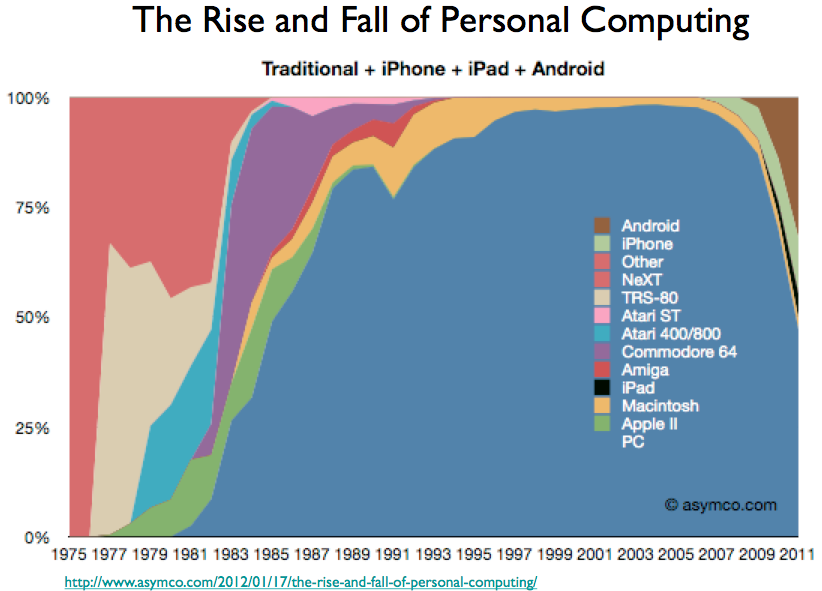
The Rise and Fall of PCs — use this slide of market share over time by device whenever you need to talk about the “post-PC age”. (via dataisugly subreddit)
Artificial Labour, Flexible Circuits, Vanishing Business Sexts, and Themal Imaging
-
Artificial Labour and Ubiquitous Interactive Machine Learning (Greg Borenstein) — in which design fiction, actual machine learning, legal discovery, and comics meet. One of the major themes to emerge in the 2H2K project is something we’ve taken to calling “artificial labor”. While we’re skeptical of the claims of artificial intelligence, we do imagine ever-more sophisticated forms of automation transforming the landscape of work and economics. Or, as John puts it, robots are Marxist.
-
Clear Flexible Circuit on a Contact Lens (Smithsonian) — ends up about 1/60th as thick as a human hair, and is as flexible.
-
Confide (GigaOm) — Enterprise SnapChat. A Sarbanes-Oxley Litigation Printer. It’s the Internet of Undiscoverable Things. Looking forward to Enterprise Omegle.
-
FLIR One — thermal imaging in phone form factor, another sensor for your panopticon. (via DIY Drones)