- ShareFest — peer-to-peer file sharing in the browser. Source on GitHub. (via Andy Baio)
- Media for Thinking the Unthinkable (Bret Victor) — “Right now, today, we can’t see the thing, at all, that’s going to be the most important 100 years from now.” We cannot see the thing. At all. But whatever that thing is — people will have to think it. And we can, right now, today, prepare powerful ways of thinking for these people. We can build the tools that make it possible to think that thing. (via Matt Jones)
- McKinsey Report on Disruptive Technologies (McKinsey) — the list: Mobile Internet; Automation of knowledge work; Internet of Things; Cloud technology; Advanced Robotics; Autonomous and near-autonomous vehicles; Next-generation genomics; Energy storage; 3D Printing; Advanced Materials; Advanced Oil and Gas exploration and recovery; Renewable energy.
- The Only Public Transcript of the Bradley Manning Trial Will be Produced on a Crowd-Funded Typewriter — [t]he fact that a volunteer stenographer is providing the only comprehensive source of information about such a monumental event is pretty absurd.
"technology" entries

Filing cabinets, GAAP, and the accountant’s dilemma
The inability to take advantage of digital technology is as big a threat to financial organizations as any fintech startup.
Learn more about Next:Money, O’Reilly’s conference focused on the fundamental transformation taking place in the finance industry.
 There’s plenty of news about the fintech, or financial technology, sector these days. Hundreds of nimble startups are disaggregating the age-old financial systems on which every transaction has relied for decades. There’s little doubt that this will continue — after all, more than four billion humans have a mobile phone, and 1.3 billion know how to use a Facebook feed, but only a billion are what we’d consider “normally banked.” Something’s got to give, and software is eating traditional financial systems one bite at a time.
But the existing financial industry isn’t just under threat from outside. Many of the processes and institutions of finance have been around for centuries, and their processes are tied to physical systems rather than digital ones. As a result, they’re unable to take advantage of digital innovations easily and remain competitive. Read more…
9.3 trillion reasons fintech could change the developing world
Modern fintech is going to create formal, standard records about economies where none existed before.

Learn more about Next:Money, O’Reilly’s conference focused on the fundamental transformation taking place in the finance industry.
A relatively commonplace occurrence — credit card fraud — made me reconsider the long-term impact of financial technology outside the Western world. I’ll get to it, but first, we need to talk about developing economies.
I’m halfway through Hernand de Soto’s The Mystery of Capital on the advice of the WSJ’s Michael Casey. Its core argument is that capitalism succeeds in the Western world and fails everywhere else because in the West, property can be turned into capital (you can mortgage a house and use that money to do something). The book uses the analogy of a hydroelectric dam as a means of unlocking the hidden, potential value of the lake.
But in much of the world, it is unclear who owns what, and as a result, the value of assets can’t be put to work in markets. In the West, we take concepts like title and lien and identity for granted; yet, these systems are relatively new and don’t exist around the world. As de Soto noted in his book, in the Soviet Union, unofficial economic activity rose from 12% in 1989 to 37% in 1994. Read more…

Here’s why finance is about to be disrupted
O'Reilly's Next:Money event helps business leaders understand the fundamental shifts reshaping finance.

Learn more about Next:Money, O’Reilly’s conference focused on the fundamental transformation taking place in the finance industry.
Editor’s note: We’re approaching an inflection point in all things “money” — currency, transactions, markets, and capitalism itself. Fundamental changes in the financial industry, driven by technology but with implications for every business and government, are beginning to manifest, bringing both disruption and opportunity. We created O’Reilly’s new conference, Next:Money to help business leaders understand and act on this shift. Below, investor and entrepreneur Paul Kedrosky lays out the forces and patterns that are reshaping the financial industry.
Finance has the three main characteristics of an industry likely to be transformed by technology:
- It traffics in bits, not atoms.
- Its services are often delivered remotely.
- There is little need for human contact.
Unlike other sectors with these characteristics — e.g., media, advertising, and travel services — finance hasn’t been disrupted. Despite huge technological change and a series of financial crises, the league table of the largest financial firms today, both in the U.S. and around the world, remains much the same as it has always been.
Granted, the $1.2-trillion U.S. financial services industry isn’t homogenous. Its main components — banks, brokers, asset managers, markets, payment networks, insurers, and credit card companies — are very different, and have seen widely varying degrees of technology-induced change. In no sense, however, is this industry as transformed by new companies and new business models as one would expect, given its disruption-ready characteristics.
So, why haven’t entrepreneurs transformed finance? There are (at least) five reasons: Read more…

WOOL author Hugh Howey is a tech optimist: The O’Reilly Radar podcast
In separate interviews, authors Hugh Howey and Ramez Naam discuss science fiction and their views of the future.
Editor’s note: you can subscribe to the O’Reilly Radar Podcast through iTunes, SoundCloud, or directly through our podcast’s RSS feed. You can download this individual episode via this link.
Science fiction long has fueled the imaginations of scientists and inspired (or foreshadowed) technological advancement. We have only to look back at the works of Isaac Asimov, or even Kurt Vonnegut, and episodes of “Star Trek” or movies like “Minority Report” for science fiction technologies that are (or nearly are) coming into existence today.
In this podcast episode, author, scientist, and futurist Ramez Naam explains to O’Reilly’s Mac Slocum that science fiction had a direct influence on his current interests in human enhancement and telepathy. Naam grew up reading science fiction (“like a lot of geeks,” he says) and once he started reading scientific journals and papers, he started seeing the connections. Naam says, “I found out that a lot of science fiction ideas were becoming actually possible — that scientists were implanting electrodes in the brains of animals and getting them to move robot arms by thought, to help people who were paralyzed.”

Four short links: 25 June 2014
Mobile Hacks, Advertising Returns, Solid Writeup, and Predicted Future
- Researchers Find and Decode the Spy Tools Governments Use to Hijack Phones (Wired) — I’m fascinated to learn there’s an Italian company making (and selling) the mobile phone rootkits that governments use.
- On the Near Impossibility of Measuring the Returns on Advertising (PDF) — Statistical evidence from the randomized trials is very weak because the individual-level sales are incredibly volatile relative to the per capita cost of a campaign—a “small” impact on a noisy dependent variable can generate positive returns. (via Slate)
- Reflections on Solid Conference — recap of the conference, great for those of us who couldn’t make it. “Software is eating the world…. Hardware gives it teeth.” – Renee DiResta
- Cybernation: The Silent Conquest (1962) — [When] computers acquire the necessary capabilities…speeded-up data processing and interpretation will be necessary if professional services are to be rendered with any adequacy. Once the computers are in operation, the need for additional professional people may be only moderate […] There will be a small, almost separate, society of people in rapport with the advanced computers. These cyberneticians will have established a relationship with their machines that cannot be shared with the average man any more than the average man today can understand the problems of molecular biology, nuclear physics, or neuropsychiatry. Indeed, many scholars will not have the capacity to share their knowledge or feeling about this new man-machine relationship. Those with the talent for the work probably will have to develop it from childhood and will be trained as intensively as the classical ballerina. (via Simon Wardley)

Mediated visions
Technology has changed, but humans haven't — what is it about mediating an experience through a frame that makes it seem better?
ImpactLab has posted a nice pair of photos contrasting 2005 and 2013 in St. Peter’s Square. 2005 looks pretty much as you’d expect: lots of people in a crowd. In 2013, though, everyone is holding up a tablet, either photographing or perhaps even watching the event through the tablet.
The ImpactLab post asks about the changes in our technology during these eight years. That’s interesting, but not what grabs me. What gets me is that this isn’t new. In the 18th century, one fad was to view nature through a portable picture frame. I wasn’t able to find this in a quick Google search, but screw the documentation. I’ve seen these things in a museum: they look like a miniature gilded picture frame, roughly the size of an iPad, with a stick coming from the corner so you can hold it before your eyes. So you’d sit in your carriage with the curtains open, look out the window through this frame, and see a moving picture. A slightly higher-tech variant of this is the Claude Glass (see, I can haz links), in which you viewed the natural scene through a slightly tinted mirror, to make it look even more like a painting. (This is arguably the origin of the term “picturesque.”) Read more…

Four short links: 6 June 2013
In-Browser p2p, Thinking About The Future, Disruptive Tech, and Crowdsourcing Transcription

Magic
Is it in the bits or atoms?
Any sufficiently advanced technology is indistinguishable from magic.
— Arthur C. Clarke
I spent Wednesday at Penn Medicine’s Connected Health event in Philadelphia. We saw an array of technologies that wouldn’t even have been imaginable when I came into this world. Mobile telepresence systems, tele surgery, the ability to remotely detect depression with merely a phone and its analysis, real-time remote glucose monitoring, and on and on.
But nothing in technology surprises me anymore. I have Meh’monia, a condition wherein all of the magic and surprise has been drained out of technology, probably by Apple. Today I expect anything that can be imagined to be possible, available, and to be executed beautifully.
A tiny but powerful computer in my pocket with greater than VGA screen resolution? Meh. Glasses with interactive heads up display? I’ll take the designer version. Hall-roaming robots that bring me my meds and let me make video calls to my family? I saw that on the Jetsons.
On my way home I dropped in at the Penn Museum and spent an hour roaming the collection. Two days later the magic I’m still thinking about is the magic in those galleries. Atoms arranged with human intellect (and vast amounts of human labor) into form with awe-inspiring scale and beauty. Many of the objects on display left me transfixed.
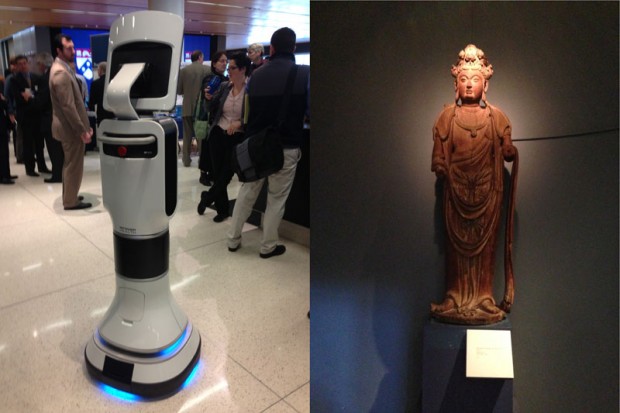
I can believe that almost anything can be designed and manufactured in modern facilities with modern methods, but the idea of a perfect 50-pound crystal sphere emerging from a piece of rock with nothing but years of hand labor seems like magic to modern me. As does a 12-ton sphinx of red granite that was quarried 600 miles from where it was carved.
The technology of our virtual world, which until very recently inspired such a sense of magic in me, has become the every day. And for me at least, those artifacts of a previous physical world now seem like the work of ancient magicians.

Printing ourselves
At its best, 3D printing can make us more human by making us whole.
Tim O’Reilly recently asked me and some other colleagues which technology seems most like magic to us. There was a thoughtful pause as we each considered the amazing innovations we read about and interact with every day.
I didn’t have to think for long. To me, the thing that seems most like magic isn’t Siri or self-driving cars or augmented reality displays. It’s 3D printing.
My reasons are different than you might think. Yes, it’s amazing that, with very little skill, we can manufacture complex objects in our homes and workshops that are made from things like plastic or wood or chocolate or even titanium. This seems an amazing act of conjuring that, just a short time ago, would have been difficult to imagine outside of the “Star Trek” set.
But the thing that makes 3D printing really special is the magic it allows us to perform: the technology is capable of making us more human. Read more…

The Falling Man and a center that cannot hold
Decoding "Mad Men's" symbol of overwhelming change.
Doug Hill on how we celebrate exponential technological advance while looking for ways to escape it.