
- Pencil — An open-source GUI prototyping tool that’s available for ALL platforms.
- lmctfy — open source version of Google’s container stack, which provides Linux application containers.
- ASCII WWDC — searchable full-text transcriptions of WWDC sessions.
- Cryptogeddon — an online infosec wargame.
"virtualization" entries

Applied DevOps and the potential of Docker
The cultural impact within a software engineering organization can be dramatic.
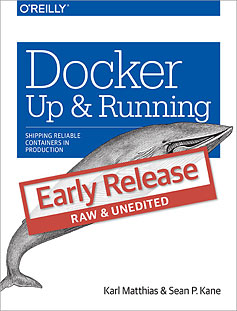
Editor’s note: this post is from Karl Matthias and Sean P. Kane, authors of “Docker Up & Running,” a guide to quickly learn how to use Docker to create packaged images for easy management, testing, and deployment of software.
At the Python Developers Conference in Santa Clara, California, on March 15th, 2013, with no pre-announcement and little fanfare, Solomon Hykes, the founder and CEO of dotCloud, gave a 5-minute lightning talk where he first introduced the world to a brand new tool for Linux called Docker. It was a response to the hardships of shipping software at scale in a fast-paced world, and takes an approach that makes it easy to map organizational processes to the principles of DevOps.
The capabilities of the typical software engineering company have often not kept pace with the quickly evolving expectations of the average technology user. Users today expect fast, reliable systems with continuous improvements, ease of use, and broad integrations. Many in the industry see the principles of DevOps as a giant leap toward building organizations that meet the challenges of delivering high quality software in today’s market. Docker is aimed at these challenges.
How to create a Swarm cluster with Docker
Using Docker Machine to create a Swarm cluster across cloud providers.
Editor’s note: this is an Early Release excerpt from Chapter 7 of Docker Cookbook by Sébastien Goasguen. The recipes in this book will help developers go from zero knowledge to distributed applications packaged and deployed within a couple of chapters. One of the key value propositions of Docker is app portability. The following will show you how to use Docker Machine to create a Swarm cluster across cloud providers.
Problem
You understand how to create a Swarm cluster manually (see Recipe 7.3), but you would like to create one with nodes in multiple public Cloud Providers and keep the UX experience of the local Docker CLI.
Solution
Use Docker Machine to start Docker hosts in several Cloud providers and bootstrap them automatically to create a swarm cluster.

OpenStack creates a structure for managing change without a benevolent dictator
Can education and peer review keep a huge open source project on track?
When does a software project grow to the point where one must explicitly think about governance? The term “governance” is stiff and gawky, but doing it well can carry a project through many a storm. Over the past couple years, the crucial OpenStack project has struggled with governance at least as much as with the technical and organizational issues of coordinating inputs from thousands of individuals and many companies.
A major milestone was the creation of the OpenStack Foundation, which I reported on in 2011. This event successfully started the participants’ engagement with the governance question, but it by no means resolved it. This past Monday, I attended some of the Open Cloud Day at O’Reilly’s Open Source convention, and talked to a lot of people working for or alongside the OpenStack Foundation about getting contributors to work together successfully in an open community. Read more…
How did we end up with a centralized Internet for the NSA to mine?
The Internet is naturally decentralized, but it's distorted by business considerations.
I’m sure it was a Wired editor, and not the author Steven Levy, who assigned the title “How the NSA Almost Killed the Internet” to yesterday’s fine article about the pressures on large social networking sites. Whoever chose the title, it’s justifiably grandiose because to many people, yes, companies such as Facebook and Google constitute what they know as the Internet. (The article also discusses threats to divide the Internet infrastructure into national segments, which I’ll touch on later.)
So my question today is: How did we get such industry concentration? Why is a network famously based on distributed processing, routing, and peer connections characterized now by a few choke points that the NSA can skim at its leisure?
Read more…


Four short links: 17 October 2013
GUI Prototyping, Linux Containerisation, Searchable Apple Text, and Infosec Wargames

How ZeroVM changes analytics in the cloud
What's so interesting about another open source virtualization platform?
 ZeroVM was the piece of technology that caught my attention during the recent Bay Area Apache Drill Meetup. What’s so interesting about another open source virtualization platform? To find out I did more reading and spoke with LiteStack founder, Camuel Gilyadov.
ZeroVM has its roots in the OpenDremel project. Camuel and his team needed a lightweight virtualization framework but couldn’t find one that suited their requirements for OpenDremel. They created ZeroVM and along the way addressed issues relevant to cloud applications, including security, multi-tenancy, and instant1 elasticity. I’m not claiming ZeroVM is mature technology, but there are two potential applications that data scientists will like: Read more…
Four short links: 2 November 2011
Deployment, Image Distribution, Open Source Sharing, and Soulless Programming
- Thoughts on Web Application Deployment (OmniTI) — if your web site is your business, this stuff is critical and it’s under-taught. Everyone learns it on the job, and there’s not a lot of standardization between gigs.
- Github Enterprise — GitHub Enterprise is delivered in the industry-standard OVF format, which means you’ll be able to run it on virtualization layers like VMware, VirtualBox, and Oracle VM. An increasingly common way to sell web apps, but it’ll trigger GPL-style distribution terms in software licenses.
- SparkleShare — open source sharing tool that markets itself as “like Dropbox”. Uses git as a backend, so you can share via github.
- Whatever Happened to Programming? — When I was fourteen, I wrote space-invader games in BASIC on a VIC-20. If you were interested in computers back in 1982, I bet you did the same. When I was 18, I wrote multi-user dungeons in C on serial terminals attached to a Sun 3. […] Today, I mostly paste libraries together. So do you, most likely, if you work in software. Doesn’t that seem anticlimactic? Any time you are in the “someone else’s code is almost right, make the changes to improve it” situation, you’re doing unsatisfying programming. It’s factory assembly of software, not craftsmanship. Welcome to the future: you have been replaced by a machine, and the machine is you.
Four short links: 23 September 2011
Visualizing Populations, Hardware Futures, Radio Different, and Kooky Javascript
- How Many Really? — project by BERG and BBC to help make sense of large numbers of people, in the context of your social network. Clever! (via BERG London)
- Why the Best Days of Open Hardware Are Yet To Come (Bunnie Huang) — as Moore’s law decelerates, there is a potential for greater standardization of platforms. A provocative picture of life in a world where Moore’s Law is breaking up. A must-read.
- Ira Glass on RadioLab — fascinating analysis of a product that’s the result of skilled creators with high standards and a desire to do things differently. Lessons for all who would be different. (via Courtney Johnston)
- Scripting Photoshop with Javascript — Javascript is the new BASIC. (via Brett Taylor)
Four short links: 20 September 2011
Android Plan 9, Virtualization OS, Rogue Games, and Wikipedia Semantics
- Plan 9 on Android — replacing the Java stack on Android fans with Inferno. Inferno is the Plan 9 operating system originally from Bell Labs.
- SmartOS — Joyent-created open source operating system built for virtualization. (via Nelson Minar)
- libtcod — open source library for creating Rogue-like games. (via Nelson Minar)
- Wikipedia Miner — toolkit for working with semantics in Wikipedia pages, e.g. find the connective topics that link two chosen topics. (via Alyona Medelyan)
Four short links: 5 August 2011
Flexible Display, Free Icons, Virtualization, and Virtualization Management
- NanoLumens — flexible display technology, 2.6lbs/sq ft (that’s 17 kilofrancs/kelvin in metric, I think). (via Fiona Romeo)
- The Noun Project — a vast collection of free-to-use icons. (via Russell Beattie)
-
VirtualBox —
SunOracle’s open source virtualization product, trivial to run multiple VMs on your local box. VirtualBoxes has pre-built VMs for common OSes. - Vagrant — tool for managing VirtualBox VMs with provisioning and teardown, NFS folder sharing, host-only networking, etc.