
The International Amateur Scanning League held an inaugural meeting on February 11 in Washington, D.C.
[ Text of the Announcement |
Photos | Mailing List ]
I’m pleased to report that things are going swimmingly, and volunteers have successfully ripped the first 42 DVDs. The duplicator that Public.Resource.Org
donated to the National Archives has been supplemented with an additional duplicator the Archivist bought, and procedures have been worked out for volunteers to sign
up for times on a spreadsheet, get a large number of blanks from the National Archives staff, and leave their completed DVDs at the reference
desk to be sent back to Public.Resource on a weekly basis. We were also pleased to learn that there are currently over 3,000 DVDs at the College
Park facility, more than twice the number we had expected.
The only minor hiccup reported by our volunteers is because NARA is a big place and not all of the staff had heard of the FedFlix
program. Ordinary researchers are only allowed 6 blank discs per visit, whereas our officially-sanctioned FedFlix volunteers are able
to take all they can eat. This was quickly remedied by our prime contact at NARA, Leslie Waffen who is Director of the Motion Picture, Sound &
Video Branch. Les sent out a memo to all research staff telling them about the program, and that seems to have done the trick.
But, it also occurred
to us that perhaps the volunteers
were not properly attired and we shared some of the blame for the miscommunication. Indeed,
it was obvious that we had forgot the first thing one needs to do when dealing with an official government institution, and that is to properly badge
the work force!
Our design team at Point.B Studio quickly developed some Official Government Scanner ID badges, which we have dispatched to the volunteers in
Washington, D.C. The badges are laminated, have a handy clip, and feature the IASL logo on the back and a FedFlix Government Scanner emblem on the front.

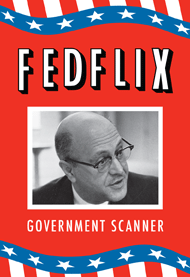
The idea of a badge with the word GOVERNMENT on it was stolen from Robert Clifton Weaver. Weaver was appointed to be
the first Secretary of Housing and Urban Development by Lyndon Johnson, and he was the first African American to hold a cabinet position.
Weaver began his government service under FDR as a newly-minted Harvard Ph.D. in Economics. He worked for Harold Ickes as one of the new breed
of so-called “Negro Advisors” that were brought into senior positions in government in a radical break from the past. He also became one of the founders of the famous
Black Cabinet, which exerted influence throughout government. Robert Weaver worked at
at the U.S. Housing Authority, a New Deal program to build public housing in the cities.
As Deputy Director of Race Relations, Robert Weaver tried to accomplish two tasks. He mostly failed in convincing cities that the new public
housing developments should be integrated. In those days, the government was still laboring under the separate but equal doctrine (which of
course definitely meant separate but certainly not equal). But, Weaver was determined that the contractors that took federal funds to build
these developments
should employ black workers at least in the proportion in which they were represented in the population. Weaver had no statutory authority
to require contractors to integrate, indeed he couldn’t get these hard-boiled developers to even talk to him. As Weaver told the story later,
he got the contractors to sit down at the table and talk to him through a little sleight of hand:
We bluffed a little bit. I had to do the identification for my staff. It looked like an FBI agent. They sealed with
‘Government’ and stamped it. Nobody ever read it and we got along very famously.
You can learn more about Robert Clifton Weaver’s path-breaking career in Wendell E. Pritchett,
Robert Clifton Weaver and the American City,
University of Chicago Press (2008) or on the Wikipedia.
With the scanning now under way, I thought I’d share with you the ID of a few of the folks that are involved in this innovative program to
crowd-source digitization. With no further ado, I invite you to Meet the Scanners!
Patron Saints of the Scanning League
From Left to Right:
Honorable Robert Clifton Weaver, 1st Secretary of H.U.D.
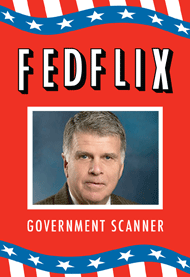
Honorable David Ferriero, 10th Archivist of the United States
Officials of the Scanning League
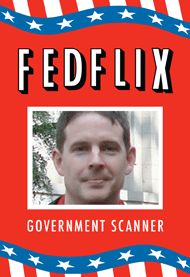
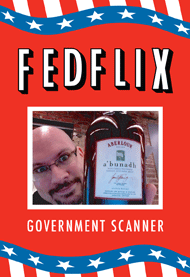
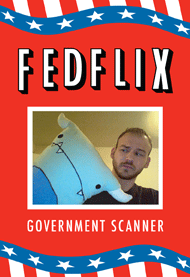
From Left to Right: Michael Edson, Thomas ‘cmdln’ Gideon, Justin Grimes
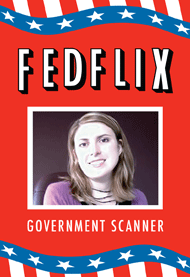
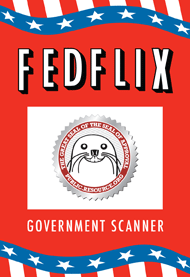
From Left to Right: Liz Pruszko, Badge for Trainees
Shipping and Receiving
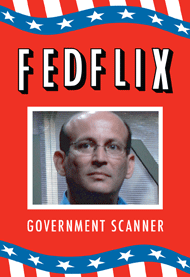
From Left to Right: Leslie Waffen (NARA), Carl Malamud (Public.Resource.Org)
Happy Mutants
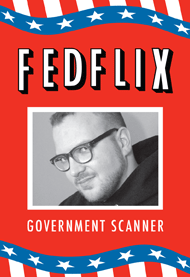


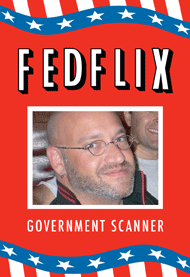
From Left to Right: Cory, Mark, Xeni, and David
Boing Boing, of course, has no official involvement with these scanning shenanigans, but they’ve done such a good job covering the
story, we thought we’d make them a set of ID badges anyway! You can read some of the prior posts on Boing Boing starting with
International Amateur Scanning League will rescue our video treasures! For further background, see also my
previous Radar post on a National Scan Center.