Andrew Odewahn

Andrew Odewahn is the CTO of O'Reilly Media, where he helps define and create new products, services, and business models that will help O'Reilly continue to make the transition to an increasingly digital future. The author of two books on database development, he has experience as a software developer and consultant in a number of industries, including manufacturing, pharmaceuticals, and publishing. Andrew has an MBA from New York University and a degree in Computer Science from the University of Alabama. He's also thru-hiked the Appalachian Trail from Georgia to Maine.
Introducing “A Field Guide to the Distributed Development Stack”
Tools to develop massively distributed applications.
Editor’s Note: At the Velocity Conference in Barcelona we launched “A Field Guide to the Distributed Development Stack.” Early response has been encouraging, with reactions ranging from “If I only had this two years ago” to “I want to give a copy of this to everyone on my team.” Below, Andrew Odewahn explains how the Guide came to be and where it goes from here.
As we developed Atlas, O’Reilly’s next-generation publishing tool, it seemed like every day we were finding interesting new tools in the DevOps space, so I started a “Sticky” for the most interesting-looking tools to explore.
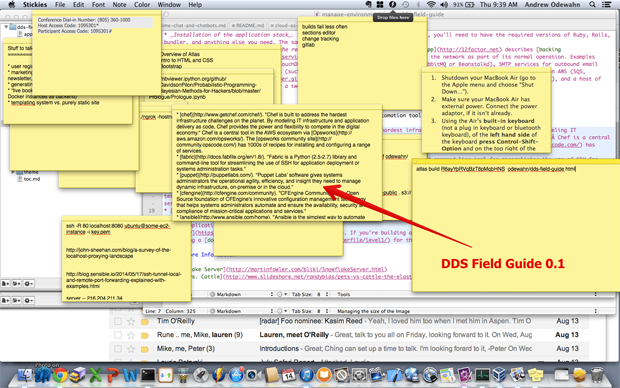
At first, this worked fine. I was content to simply keep a list, where my only ordering criteria was “Huh, that looks cool. Someday when I have time, I’ll take a look at that,” in the same way you might buy an exercise DVD and then only occasionally pull it out and think “Huh, someday I’ll get to that.” But, as anyone who has watched DevOps for any length of time can tell you, it’s a space bursting with interesting and exciting new tools, so my list and guilt quickly got out of hand.
Health 2.0 / MAKE Developer Challenge happening this weekend in Boston
The Health 2.0 / MAKE Developer Challenge is happening this weekend, Feb 19th, in Boston. If you haven’t signed up already, register now, because it’s filling up fast.
Hacking for health: Health 2.0 Developer Challenge
Indu Subaiya on the intersection of data, developers and healthcare.
Health 2.0 is hosting code-a-thons in San Francisco, Washington, D.C., and Boston as part of their Developer Challenge. Indu Subaiya, director of the Developer Challenge, discusses the competion and the intersection of data and healthcare in the following interview.
Earthquakes are HUGE on Data.gov
Checking in on Data.gov roughly one year later
After launching just over a year ago with only 47 data sets, the Data.gov catalog now has 2,326 entries that have been collectively downloaded almost three-quarters of a million times. The big Data.gov winner so far? The Department of the Interior’s “Worldwide M1+ Earthquakes, Past 7 Days” data set. Here’s a look at the top 10 downloads.
Lies, damn lies, and visualizations
The intersection -- and accompanying questions -- of data science and journalism.
There's nothing wrong with taking a strong position, assuming the underlying data and facts are accurate. But it's important for the audience to recognize it as advocacy, not as strict science, even when it comes wrapped in a really cool visualization.
iPhone economics and lower barriers to entry
The power of the App Store is defined by more than direct revenue.
The App Store has exposed incumbents in the mobile industry to the same sort of asymmetric competition that has reshaped the media industry over the past decade. Developers are responding in droves to the economic incentives that lower barriers to entry create, as well as the fact that the App Store has generated $1 billion in royalty payments in just a few years.
Visualizing the Senate social graph, revisited
How the addition of animation and interactivity improved a visualization.
The addition of animation and interactivity breathes new life — and insight — into a Senate voting visualization. Andrew Odewahn discusses his visualization process and how revisions made a big difference.
Visualization of Interests at Web 2.0 Summit
To help make the most of this week's Web 2.0 Summit, I wanted to understand the overall audience gestalt – what are the broad themes, interests, and ideas that are important to the people going to the conference? A tag cloud can be a great (but admittedly imperfect!) way to understand these large patterns quickly, so I used a spider…