- focusmotion.io — the world’s first machine learning SDK to track, learn, and analyze human motion on any sensor, on any OS, on any platform. You (or your users) train it on what combination of sensor patterns to label as a particular gesture or movement, and then it’ll throw those labels whenever.
- How Maintainers, not Innovators, Make the World Turn (City Lab) — cf Deb Chachra’s Why I Am Not a Maker and everything Warren Buffett ever wrote about investing in boring businesses. It’s nice to realize that we’ve gone from “you’d be crazy to throw your career away and join a startup” to “hey, established industry isn’t bad, either, you know.”
- Google CS Education — all their tools and resources for CS education in one spot.
- Will The Proliferation of Affordable AI Decimate the Middle Class? (Alex Tabarrok) — I hadn’t heard this done before, but he steps away from the A in AI to ask whether greater natural intelligence would threaten the middle class in the same way—e.g., from rising India and China.
"wearables" entries

Four short links: 13 April 2016
Gesture Learner, Valuing Maintainers, Google's CS Education, and AI Threats
Four short links: 4 February 2016
Shmoocon Video, Smart Watchstrap, Generalizing Learning, and Dataflow vs Spark
- Shmoocon 2016 Videos (Internet Archive) — videos of the talks from an astonishingly good security conference.
- TipTalk — Samsung watchstrap that is the smart device … put your finger in your ear to hear the call. You had me at put my finger in my ear. (via WaPo)
- Ecorithms — Leslie Valiant at Harvard broadened the concept of an algorithm into an “ecorithm,” which is a learning algorithm that “runs” on any system capable of interacting with its physical environment. Algorithms apply to computational systems, but ecorithms can apply to biological organisms or entire species. The concept draws a computational equivalence between the way that individuals learn and the way that entire ecosystems evolve. In both cases, ecorithms describe adaptive behavior in a mechanistic way.
- Dataflow/Beam vs Spark (Google Cloud) — To highlight the distinguishing features of the Dataflow model, we’ll be comparing code side-by-side with Spark code snippets. Spark has had a huge and positive impact on the industry thanks to doing a number of things much better than other systems had done before. But Dataflow holds distinct advantages in programming model flexibility, power, and expressiveness, particularly in the out-of-order processing and real-time session management arenas.
Four short links: 20 August 2015
Automata Class, Low-UI Wearables, Broken Science, and Understandable Eigenvectors

Mind if I interrupt you?
Notification centers and Apple Watches beg the question: what’s the best way to interrupt us properly?
We’ve been claiming information overload for decades, if not centuries. As a species, we’re pretty good at inventing new tools to deal with the problems of increasing information: language, libraries, broadcast, search, news feeds. A digital, always-on lifestyle certainly presents new challenges, but we’re quickly creating prosthetic filters to help us cope.
Now there’s a new generation of information management tools, in the form of wearables and watches. But notification centers and Apple Watches beg the question: what’s the best way to interrupt us properly? Already, tables of friends take periodic “phone breaks” to check in on their virtual worlds, something that might have been considered unthinkably gauche a few years ago.
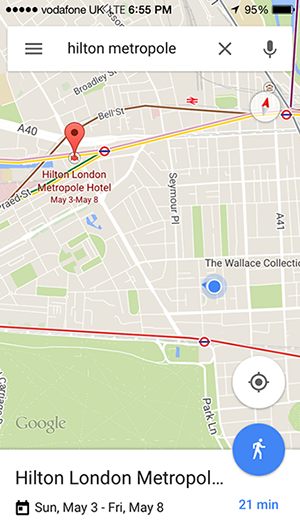 Since the first phone let us ring a bell, uninvited, in a far-off house, we’ve been dealing with interruption. Smart interruption is useful: Stewart Brand said that the right information at the right time just changes your life; it follows, then, that the perfect interface is one that’s invisible until it’s needed, the way Google inserts hotel dates on a map, or flight times in your calendar, or reminders when you have to leave for your next meeting.
But all of this technology is interfering with reflection, introspection, and contemplation. In Alone Together, Sheri Turkle observes that it’s far easier to engage with tools like Facebook than it is to connect with actual humans because interactive technology’s availability makes it a junk-food substitute for actual interaction. My friend Hugh McGuire recently waxed rather poetically on the risks of constant interruption, and how he’d forgotten how to read because of it.
At work, modern productivity tools like Slack might do away with email conventions, encouraging better collaboration, but they do so at a cost because they work in a way that demands immediate attention, and that interrupts the natural rhythm we all need to write, to read, and to immerse ourselves in our surroundings. It’s hard to marinate when you’re being interrupted. Read more…
Four short links: 19 May 2015
Wrist Interactions, Kubernetes Open Source Success, Product Quality, and Value of Privacy
- Android Wear vs Apple Watch (Luke Wroblewski) — comparison of interactions and experiences.
- Eric Brewer on Kubernetes — interesting not only for insights into Google’s efforts around Kubernetes but for: There’s so much excitement we can hardly handle all the pull requests. I think we’re committing, based on the GitHub log, something like 40 per day right now, and the demand is higher than that. Each of those takes reviews and, of course, there’s a wide variety of quality on those. Some are easy to review and some are quite hard to review. It’s a success problem, and we’re happy to have it. We did scale up the team to try and improve its velocity, but also just improve our ability to interact with all of the open source world that legitimately wants to contribute and has a lot to contribute. I’m very excited that the velocity is here, but it’s moving so fast it’s hard to even know all the things that change day to day. Makes a welcome change from the code dumps that are some of Google’s other high-profile projects.
- We Don’t Sell Saddles Here — Stewart Butterfield, to his team, on product development and quality. Every word of this is true for every other product, too.
- What is Privacy Worth? (PDF) — When endowed with the $10 untrackable card, 60.0% of subjects claimed they would keep it; however, when endowed with the $12 trackable card only 33.3% of subjects claimed they would switch to the untrackable card. […] This research raises doubts about individuals’ abilities to rationally navigate issues of privacy. From choosing whether or not to join a grocery loyalty program, to posting embarrassing personal information on a public website, individuals constantly make privacy-relevant decisions which impact their well-being. The finding that non-normative factors powerfully influence individual privacy valuations may signal the appropriateness of policy interventions.
Apple Watch and the skin as interface
The success of Apple’s watch, and of wearables in general, may depend on brain plasticity.
Recently, to much fanfare, Apple launched a watch. Reviews were mixed. And the watch may thrive — after all, once upon a time, nobody knew they needed a tablet or an iPod. But at the same time, today’s tech consumer is markedly different from those at the dawn of the Web, and the watch faces a different market all together.
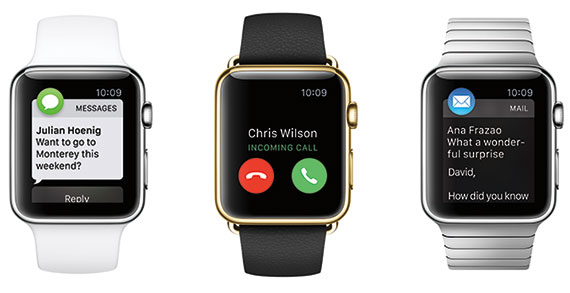
Apple Watches. Source: Apple.
One of the more positive reviews came from tech columnist Farhad Manjoo. In it, he argued that we’ll eventually give in to wearables for a variety of reasons.
“It was only on Day 4 that I began appreciating the ways in which the elegant $650 computer on my wrist was more than just another screen,” he wrote. “By notifying me of digital events as soon as they happened, and letting me act on them instantly, without having to fumble for my phone, the Watch became something like a natural extension of my body — a direct link, in a way that I’ve never felt before, from the digital world to my brain.”
On-body messaging and brain plasticity
Manjoo uses the term “on-body messaging” to describe the variety of specific vibrations the watch emits, and how quickly he came to accept them as second nature. The success of Apple’s watch, and of wearables in general, may be due to this brain plasticity. Read more…
Four short links: 4 March 2015
Go Microservices, Watch Experience, Multithreading Bugs, and Spooks Ahoy
- Microservices in Go — tale of rewriting a Ruby monolith as Go microservices. Interesting, though being delivered at Gophercon India suggests the ending is probably not unhappy.
- Watch & Wear (John Cross Neumann) — Android watch as predictor of the value and experience of an Apple Watch. I believe this is the true sweet spot for meaningful wearable experiences. Information that matters to you in the moment, but requires no intervention. Wear actually does this extremely well through Google Now. Traffic, Time to Home, Reminders, Friend’s Birthdays, and Travel Information all work beautifully. […] After some real experience with Wear, I think what is more important is to consider what Apple Watch is missing: Google Services. Google Services are a big component of what can make wearing a tiny screen on your wrist meaningful and personal. I wouldn’t be surprised after the initial wave of apps through the app store if Google Now ends up being the killer app for Apple Watch.
- Solving 11 Likely Problems In Your Multithreaded Code (Joe Duffy) — a good breakdown of concurrency problems, including lower-level ones than high-level languages expose. But beware. If you try this [accessing variables with synchronisation] on a misaligned memory location, or a location that isn’t naturally sized, you can encounter a read or write tearing. Tearing occurs because reading or writing such locations actually involves multiple physical memory operations. Concurrent updates can happen in between these, potentially causing the resultant value to be some blend of the before and after values.
- Obama Sharply Criticizes China’s Plans for New Technology Rules (Reuters) — In an interview with Reuters, Obama said he was concerned about Beijing’s plans for a far-reaching counterterrorism law that would require technology firms to hand over encryption keys, the passcodes that help protect data, and install security “backdoors” in their systems to give Chinese authorities surveillance access. Goose sauce is NOT gander sauce! NOT! Mmm, delicious spook sauce.
The Internet of Things has four big data problems
The IoT and big data are two sides of the same coin; building one without considering the other is a recipe for doom.
The Internet of Things (IoT) has a data problem. Well, four data problems. Walking the halls of CES in Las Vegas last week, it’s abundantly clear that the IoT is hot. Everyone is claiming to be the world’s smartest something. But that sprawl of devices, lacking context, with fragmented user groups, is a huge challenge for the burgeoning industry.
What the IoT needs is data. Big data and the IoT are two sides of the same coin. The IoT collects data from myriad sensors; that data is classified, organized, and used to make automated decisions; and the IoT, in turn, acts on it. It’s precisely this ever-accelerating feedback loop that makes the coin as a whole so compelling.
Nowhere are the IoT’s data problems more obvious than with that darling of the connected tomorrow known as the wearable. Read more…
Four short links: 1 January 2015
Wearables Killer App, Open Government Data, Gender From Name, and DVCS for Geodata
- Killer App for Wearables (Fortune) — While many corporations are still waiting to see what the “killer app” for wearables is, Disney invented one. The company launched the RFID-enabled MagicBands just over a year ago. Since then, they’ve given out more than 9 million of them. Disney says 75% of MagicBand users engage with the “experience”—a website called MyMagic+—before their visit to the park. Online, they can connect their wristband to a credit card, book fast passes (which let you reserve up to three rides without having to wait in line), and even order food ahead of time. […] Already, Disney says, MagicBands have led to increased spending at the park.
- USA Govt Depts Progress on Open Data Policy (labs.data.gov) — nice dashboard, but who will be watching it and what squeeze will they apply?
- globalnamedata — We have collected birth record data from the United States and the United Kingdom across a number of years for all births in the two countries and are releasing the collected and cleaned up data here. We have also generated a simple gender classifier based on incidence of gender by name.
- geogig — an open source tool that draws inspiration from Git, but adapts its core concepts to handle distributed versioning of geospatial data.
Four short links: 2 December 2014
e-Paper Watch, Probabilistic Go, Z-Machine in Hardware, and Glorious Underlines
- FES Watch — e-paper watch, including strap. Beautiful, crowdfunded, made by a Sony subsidiary that’s looking at e-ink for wearables and more. (via The Verge)
- Probabilistic Data Structures for Go — introduction to the go-probably library for when you can’t store every single value, so will trade off memory usage against accuracy.
- Z3 — implementation of the Infocom Z-Machine in hardware. Check out the easter eggs. I look upon my works and despair.
- Towards a More Perfect Link Underline — glorious typography on the web. A phrase you don’t often hear together without “would be a nice thing” at the end of the sentence.